|
FEATURE von Christoph Kappler >> |
|
FEATURE von Alexander Roob >> |
|
PICTORIAL JUNE 08 Tracing #2 «News» von Reinhard Doubrawa >> |
W. J. Linton: Poems, Pamphlets, Illustrations, Editorial-Work and Graver-Work. >> |
Until July 28, the Parisian Galerie Jocelyn Wolff presents drawing-based work by Franz Erhard Walther (*1939). The new work "Sternenstaub - A Drawn Novel" (2007/08) consists of several hundred (photocopies of) pencil-on-paper drawings tacked to the wall, each of them detailing memorable occurrences and encounters from the artist's life - in a style vaguely reminiscent of Jim Shaw's "Dream Drawings," only much more painstakingly organised. Another work on display is his early "New York Book" consisting of some five hundred pages with watercolors and conceptual text work. Walther - who is much better known for the interactive installation pieces that he developed from the early 1960s on, of which some early samples are exhibited in Paris, too – here gives a rare glimpse into another field of work, spanning four decades with two bookish works. A closer look than our illustration can offer is recommended. (Clemens Krümmel)
Galerie Jocelyn Wolff, 78 rue Julien-Lacroix, Paris, until July 28, 2008
http://www.galeriewolff.com/site/index.php

bitumen, blood and the carbon climb
Drawings, sculptures and a animation film by Canadian artist Susan Turcot
In her recent works, Susan Turcot has adopted a variety of reportage techniques and has made a significant point of examining the time-based, processual and functional equation that "live" drawing and its medialized representations can set up for the viewer. She investigates large-scale ecological and economical processes such as deforestation and the exploitation of other natural resources, working and recording in situ and then employing tropes of the illustrative, the diagrammatic, the model-like in juxtaposition. Pencil / graphite drawings of different dimensions expose a vertical layering and, through it, also a historical quality of human industry as an ongoing serious of intrusions. Large mobile-shaped scale models made of welded metal that represent extraction sites are placed in polemic confrontation with a similar-looking model of Abu Ghraib and convey a sense of gnomic materiality that Turcot keeps - in all its first-look didacticist appearance - largely opaque to attempts of easy interpretation. The gnomic character becomes even more important in a row of roughly face-shaped objects on the wall that are made of massive graphite and introduce a conceptual circularity into the structure of the exhibition by intimating that these "masks" could again be used as drawing instruments. Turcot's approach is based on a highly developed textural and structural sense that she employs in the (long-term) processual visualization of her own becoming an "informed viewer" – as well as a finder of symbolical layers that connect her vision to processes of perception related to ecological facts that have long become almost "unmanageable" in the field of art. Her use of "slow" media like drawing and modeling is complemented by a video animation work that combines a visual accretion of semi-abstract drawn forms with an acoustic environment contributed by percussionist Roger Turner that takes up and counterpoints Turcot's shifting movements between the naturalistic and the abstract in drawing. (Clemens Krümmel)
Galerie Arndt & Partner, Zimmerstrasse 90-91 , 10117 Berlin

From a series of 10 masks
Resin, graphite and mesh
approx. 10 x 15 cm / 3.93 x 5.9 in , (Courtesy Arndt & Partner)
Good news for all those who missed the last MePri lecture: on the website of Princeton University you can find a streaming version of a lecture Ben Katchor held on "Halftone Printing in the Yiddish Press and Other Objects of Idol Worship."
"A forty-minute slide-show / lecture expanding upon the theme of image worship as presented in my book 'The Jew of New York'. Through an examination of the use of photographic reproduction in a variety of 20th century Yiddish books and newspapers, I will endeavor to explain how Jewish proscriptions against the establishment of idolatrous images have influenced, and been influenced by, modern printing technology. Are the photographic images one finds in the Yiddish press of an intentionally low quality, or have they been degraded by accident? At what point is one no longer able to 'read' a photographic image, and when does one turn by necessity to its text caption? I will demonstrate how certain potentially dangerous symbols are reduced by the vagaries of the printing process to harmless signs pointing to a momentary event in the real world. Part two of the this lecture examines the possibility of finding other forms of graphic representation to excite our collective memory of persons and places." (Ben Katchor)
http://www.princeton.edu/WebMedia/special/
scroll down to October 21 through 23, 2001 - Conference: Celebration of Jewish-American Writers

Der Vortrag von Ben Katchor „Reading in Public“ dreht sich um die Geschichte der öffentlichen Lesesäle von New York City, die „eine Menge zu tun hat mit den Antagonismen zwischen Text und Bild.“ (Ben Katchor)
Ben Katchor zählt zu den renommiertesten und eigenwilligsten Exponenten des „Independent American Comic“. Seine Publikationen um den Immobilienfotografen Julius Knipl, der sich wie ein wandelndes Kameraauge durch arkane Bereiche
einer imaginären New Yorker Alltagswelt bewegt, sowie seine vielschichtige graphische Historienerzählung um den „Jew of New York“ finden mittlerweile ein internationale Verbreitung und haben ihm eine Reihe von Preisen und Fellowships in den Bereichen von Kunst und Literatur eingebracht.
Katchor liefert regelmässig „Picture stories“ für den „New Yorker“, die „New York Times“ und das renommierte Architekturmagazin „Metropolis Magazine“. Daneben hat er zahlreiche Musiktheaterstücke geschrieben und in Szene gesetzt. Er lehrt im Department Illustration an der Parsons New School of Design New York und forscht zur Zeit über die Entwicklung der Milchrestaurants im neunzehnten Jahrhundert.
Der Vortrag wird in englischer Sprache gehalten.
Montag, 9. Juni um 19 Uhr
Staatliche Akademie der Bildenden Künste Stuttgart, Am Weißenhof 1, Alte Aula Altbau

Die Exposition internationale du Surréalisme von 1938 ist ein Mythos sowohl für die Kunstgeschichtsschreibung wie für die Entwicklung neuer Ausstellungsformen. André Breton, Giorgio de Chirico, Salvador Dalí, Marcel Duchamp, Max Ernst, Alberto Giacometti u.a. - ihnen ist mit dieser revolutionären Ausstellung nicht nur der Gegenentwurf zur traditionellen Galerieausstellung gelungen. In ihrer umfassenden und exzellent recherchierten Untersuchung präsentiert Annabelle Görgen eine Fülle neuen Materials und leistet - besonders mit der Entdeckung der Arts incohérents als Vorläufer im 19. Jh. - einen außerordentlichen Beitrag zur kunsthistorischen Forschung der Moderne.
Dr. Annabelle Görgen, Promotion an der Hochschule für Bildende Künste Braunschweig, ist Kuratorin an der Hambuger Kunsthalle.
München 2008, Silke Schreiber Verlag, 312 Seiten, 148 Abb., 24 x 18 cm, broschiert
ISBN 978-3-88960-074-5
Das surrealistische Verfahren der poetischen Zündung, die Methode der Kombinatorik, und der häufig sprachspielerische und schwarze Humor erhalten durch die Erforschung einer wenig bekannten Pariser Künstlergruppe des späten 19. Jahrhunderts einen neuen historischen Hintergrund: Die Arts incohérents waren zwischen 1882 und 1893 eine Gruppe von Kunstparodisten, die sich selbst nicht ernst nahm. Doch die Rolle der „inkohärenten Künste“ als Vorläufer und Anreger der Surrealisten wird offensichtlich in Gegenüberstellungen von surrealistischen und inkohärenten Werken und Objekten – wie Duchamps L.H.O.O.Q. oder Magrittes und Dalís Venus, – aber auch von Arbeitsmethoden und Grundlagen wie Haltung zum Bürgertum, zum Lachen, zur Stellung zwischen Kunst und Spektakel, zum Selbstverständnis der Künstler etc.. Die vergessene Künstlergruppe muß daher aus heutiger Sicht ernst genommen werden, wie die Abhängigkeit der Werke der Surrealisten von dem Fumismus – der Blufferei – des 19. Jahrhunderts. Dies gilt umso mehr, als Belege für konkrete Kenntnis der Arts incohérents durch Breton und Duchamp geliefert werden können.
Dienstag, 27. Mai um 19 Uhr
Staatliche Akademie der Bildenden Künste Stuttgart, Alte Aula Altbau


Dass ausgerechnet seine Hauspostille, die FAZ, in ihrer Besprechung vom 18.4. die Bernard Buffet-Ausstellung im Museum für Moderne Kunst in Frankfurt über den grünen Klee gelobt hatte und eine komplette Neubewertung seiner Kunst in Aussicht gestellt hat (MePri News, 27.4.), das muss Werner Spies, dem ewigen Erbverwalter und Grossinquisitor der klassischen Moderne förmlich den Magen verdreht haben. Eine dreistere Attacke auf seine aristotelische Weltordnung war wohl ihm noch nie untergekommen. Hatte die Rezensentin Rose-Marie Gropp mit einer Aufhebung der Exkommunikation des gebannten Malers nicht auch eine Neujustierung des Spies´schen Götterhimmels in den Horizont des Möglichen gerückt - Buffet gleichrangig mit Picasso "und vielleicht noch darüber hinaus"? Hier musste also ein deutliches Machtwort gesprochen werden.
Spies´ Empörung hat der FAZ- Leserschaft nun in der Sonntagsausgabe vom 4.5. eine weitere, weitaus umfänglichere und besser bebilderte Besprechung der Ausstellung beschert. Schlichtweg "irreversibel", so Spies, sei das einmal gesprochene Verdikt zum Fall Buffet, diesem "größten Ärgernis der jüngeren Kunstgeschichte", das in einer "existenzphilosophischen Irrigation (Darmspülung)" bestehe. In der Strategie, die Kunst des 1999 verstorbenen Malers, den er "eine Leiche" nennt, durch ein entsprechendes Vokabular in den Bereich des Unappetitlichen und Widerwärtigen zu rücken, steht Spies´Beitrag ganz in der Nachfolge des Leitartikels des "Spiegel" vom 11.7.1956 , der mit einem sprachlichen Gestus, der erschreckend nah an der "Stürmer"- Presse gebaut war, die Hetzjagd auf Buffet im deutschsprachigen zu Mitte der fünfziger Jahre in Gang gesetzt hatte.
Spies` eisige Konservierung uralter Feme basiert argumentativ einzig auf der Behauptung, dass sich Buffets Kunst epigonal zu einer Stilphase Picassos zur Zeit der Pariser Okkupation verhalte. Was allerdings an den im Artikel abgebildeten Arbeiten von Buffet picassoesk zu nennen wäre, das bleibt ein Rätsel. Möglicherweise ist er der Ansicht, dass im Grunde die komplette Tradition der ligne claire der bande dessinée einen einzigen Ausfluss aus dem Demiurgen Picasso vorstellt. Wer weiß? - Und noch was: bar jeder Ironie sei diese Kunst. Da gebe es keinen doppelten Boden. Buffet meint was er malt. Auch das ist schlimm.

Dass die Hybris von Spies, die sich im Windschatten seines spanischen Über-Ichs entwickelt hat, mittlerweile zu einem pluralis maiestatis angeschwollen ist, das mag das eigentliche, bedrückende Fazit seines Beitrags sein, der zu folgendem Schluss kommt: "In gewissem Sinne begegnen wir bei unserer heutigen, sicheren Ablehnung letztlich der Scham über frühere, vorschnelle Enthusiasmen". Punkt.
Alexander Roob
Werner Spies: "Der Kampf um Buffet. In Frankfurt wird eine Leiche wiederbelebt.", FAZ, 4.5.2008
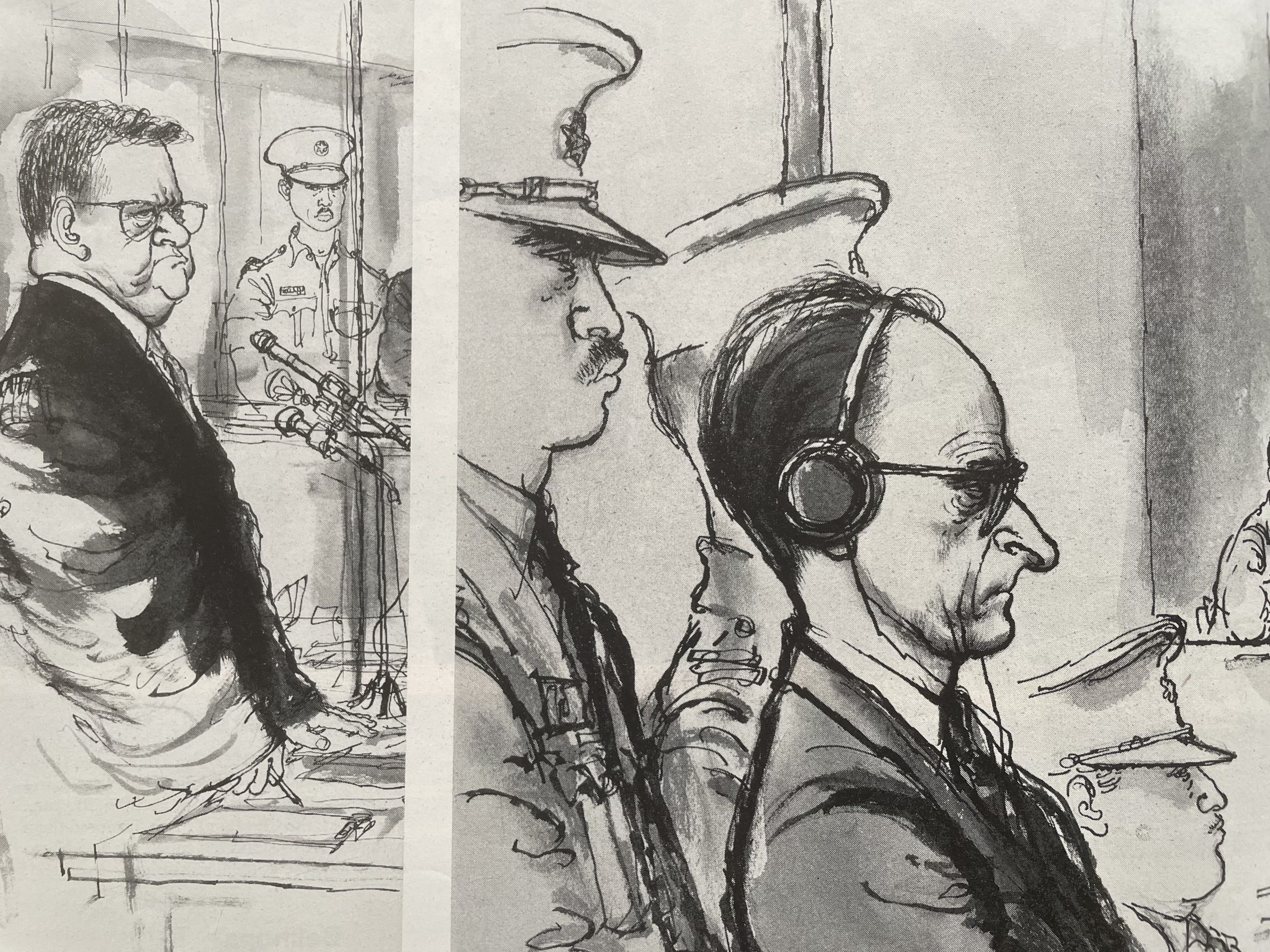
This drawing, highlight of a series of a total of eight by American war artist Herbert C. Hahn, is certainly a haunting graphic document of the armistice talks during the Korean War that started at Kaesong on July 10, 1951 and lasted until August 22, 1951. Initially, both sides – the North Korean and Chinese as well as the South Korean and American Alliances – expected these peace talks to last for only three to six weeks, but they deadlocked and broke off. Hahn, who had initially been assigned as photographer to the U.S. Navy but whose ambition it was to continue his work as a draughtsman and painter, had top security clearance and was thus able to do sketches on the spot. The drawing below, which he left in a state of elaborate unfinishedness (a manner he obviously preferred) is marked „Conference Room, Peack House, Kaesong – Aug.15, '51.

The following depiction of an organ may exemplify Hahns extraordinarily slick graphic style, which was influenced by the advertising art of his day. He probably executed it in the late 1940s when he was working on the illustrations to Ralph B. Wright's Christian fundamentalist book on "California's Missions" that was published in Santa Barbara in 1950. Hahn worked on military training films produced in Hollywood studios and was one of Senator Ronald Reagan's favorite artists.

The Museum für Moderne Kunst in Frankfurt/Main, Germany, is currently presenting a retrospective exhibition of the works of Bernard Buffet, a painting legend of the 1950s and 1960s that has long been pushed aside and neglected in reassessments of the art of that period.
The exhibition "Diving Trips. Drawing as reportage" that has been shown at Kunstverein Hannover and Kunsthalle Düsseldorf in 2004/2005 featured two of Buffet's drawn reportages of industrial life, a portrait of the Burda factory facilities in Offenburg as well as a graphic documentary of Siemens corporation. In the context of that exhibition, his works were confronted with a graphic cycle by the late Alberto Giacometti: "Paris sans fin".
"(The show in) Frankfurt offers a unique opportunity to reconsider Bernard Buffet as an artistic phenomenon - minus all the griping and the official blinders, without the reservations against the work of this paintaholic, without hypocritical orthodoxies raised against him. The door is now wide open again for an art historically informed reassessment that might succeed in shaking off previous limitations. Is it imaginable to - again - to mention this man's name in one breath with Picasso, with his early pink and blue images of jugglers, or perhaps even beyond individual comparisons? Can he hold his own alongside Giacometti? Is his art powerful enough to to make him our contemporary?" (Rose-Maria Gropp, FAZ, April 18, 2008)
The exhibition in Frankfurt is on view until August 3, 2008. A catalogue documenting the exhibition and working off some of the Buffet case's inconsistencies will soon be published.
Das Museum für Moderne Kunst in Frankfurt zeigt eine Retrospektive des lange verdrängten und vergessenen Malerstars der fünfziger und sechziger Jahre.
In der Ausstellung "Tauchfahrten. Zeichnung als Reportage", die 2004/2005 im Kunstverein Hannover und der Kunsthalle Düsseldorf stattfand, war Bernard Buffet mit zwei Industriereportagen der sechziger Jahre vertreten, mit einem Porträt der Burda-Werke in Offenburg, sowie einer graphischen Dokumentation des Siemens-Konzerns. Konfrontiert waren seine Arbeiten mit einem späten Radierzyklus von Alberto Giacometti:"Paris sans fin".
"Frankfurt eröffnet die Chance, sich dem Phänomen Bernard Buffet neu zu nähern - ohne die Mauligkeiten und verordneten Scheuklappen, ohne die Berührungsängste mit dem Werk eines Vielmalers und die scheinheilige Orthodoxie. Die Tür ist wieder aufgestoßen für eine Wertung aus dem Geist der Geschichte, die sich von allfälligen Diktaten befreien kann. Ob man den Mann - wieder - im Zusammenhang nennen darf mit Picasso, mit dessen frühen Artisten in Blau und Rosa, und vielleicht noch darüber hinaus? Besteht er neben Giacometti? Reicht seine Kraft womöglich bis in unsere Zeitgenossenschaft?" (Rose-Maria Gropp, FAZ, 18.4.2008)
Die Ausstellung in Frankfurt ist noch bis zum 3.8.2008 zu sehen. Ein Katalogbuch, das die Ausstellung dokumentiert und den Fall Buffet aufarbeitet, ist in Vorbereitung.

(Der Spiegel, 11. Juli 1956)
With this month’s update, we have changed the shape of our website (Thanks are due to Lena and Julius Roob!) The overall look is slightly changed, but most of all: In order to accomodate more frequent and shorter updates, this site has now become much closer to a blog format. Announcements of new contributions will always appear in the blog column first and will then be transferred to the respective archives on the other levels of the site. Through these changes, we hope to be able to provide more spontaneous and discursive types of information. As always, we appreciate your opinion and any other input that you may find relevant for the Institute’s research.
Mit dem Update dieses Monats präsentieren wir Ihnen unsere Website in einer veränderten Form (für deren Gestaltung wir Lena und Julius Roob großen Dank schulden!). Die Gesamtgestaltung hat sich leicht gewandelt, doch vor allem hat sich die Startseite geändert: Um häufigere und auch kürzere Updates zu ermöglichen, ist diese nun im Blogformat angelegt. Das bedeutet, dass Ankündigungen neuer Beiträge immer zuerst in der Blog-Spalte erscheinen und dann nach einer Weile in die entsprechenden Archive an anderen Stellen der Website übertragen werden. Durch die Veränderungen hoffen wir, Sie mit spontaneren und diskursiveren Informationstypen versorgen zu können. Wie immer ist uns auch hierbei sehr an Ihrer Meinung gelegen – und an allen Beiträgen, die Sie für die Belange des Instituts für relevant erachten.
The Melton Prior website now offers a collection of links and a completely new special section: the William James Linton Archive.
This archive keeps substantial collections on the history and practice of wood engraving, a printing technique that held central significance for the rise of the illustrated press as a mass medium. With our multi-faceted commented bibliography, we will provide a sceletal guide through the interwoven histories of radical culture and relief printing processes.
The first part focusses on the works of the archive’s eponym W.J. Linton,
the engraver, publisher, poet and influential historian of xylography.
the William James Linton Archive
The process of building the William James Linton Archive has been substantially inspired by the artistic mindset that becomes apparent in the microscopically detailed miniature painting of artist Simon Lewis. In this sense, the painting "...the wood for the trees", measuring only 10 x 10 cm, is a true cornerstone of the archive.
Pictorial: Thorsten Streichardt-Salzburg Lint
The minimal pencil marks presented in this month's pictorial that Berlin-based artist Thorsten Streichardt is creating at the threshold of the visible, come from his residency in Salzburg, Austria, two years ago.